Ready-to-sign CT reports.
Not an overlay.
A full report.
AI radiology reporting for outpatient imaging centers and teleradiology providers. Head, chest, and abdomen CT — two AI layers + review by our in-house European radiologists at narrow AI pricing. 2–12 hr TAT
Built for outpatient CT workflows
Outpatient imaging centers
Expand CT capacity without adding headcount. Get ready-to-sign reports back in 2–12 hours — reduce radiologist hours without sacrificing coverage
Learn more →Teleradiology providers
Scale your read volume with AI CT reporting that delivers complete ready-to-sign reports with radiologist review, not just detection flags. DICOM in, HL7 out — setup under one week
Learn more →Radiology groups
Cover overflow, after-hours, and scheduled CT reads without locum costs. Free your radiologists for complex cases
Learn more →Small & community hospitals
24/7 CT coverage with no after-hours surcharge and no FTE commitment. Per-study pricing, setup under one week, BAA included
Learn more →Radiology groups face mounting pressure
Hiring takes 12+ months
The average time-to-hire for a radiologist exceeds 12 months. Meanwhile your CT volume grows and revenue walks out the door
On-demand coverage is eating your margins
Locum and on-call radiologists are expensive — and unpredictable. Every extra shift chips away at profit you've already earned
Current AI doesn't save time
AI overlays improve detection rates — but radiologists still dictate the full report. TAT stays exactly the same
Three simple steps from scan to ready-to-sign report
You send us the CT
Push scans via standard DICOM. Setup takes under a week
AI + radiologist produce the report
Our foundation models analyze 100+ findings. Our in-house European radiologists review every report, comparing against prior CT studies when supplied
Ready-to-sign report in your system
Delivered via HL7 directly into your reporting system, ready to sign. The final signature stays with your radiologist
— or we reimburse
No other AI vendor offers a money-back accuracy guarantee
Two AI layers + radiologist review —
at the price of narrow AI
Compare xAID against what you're currently using
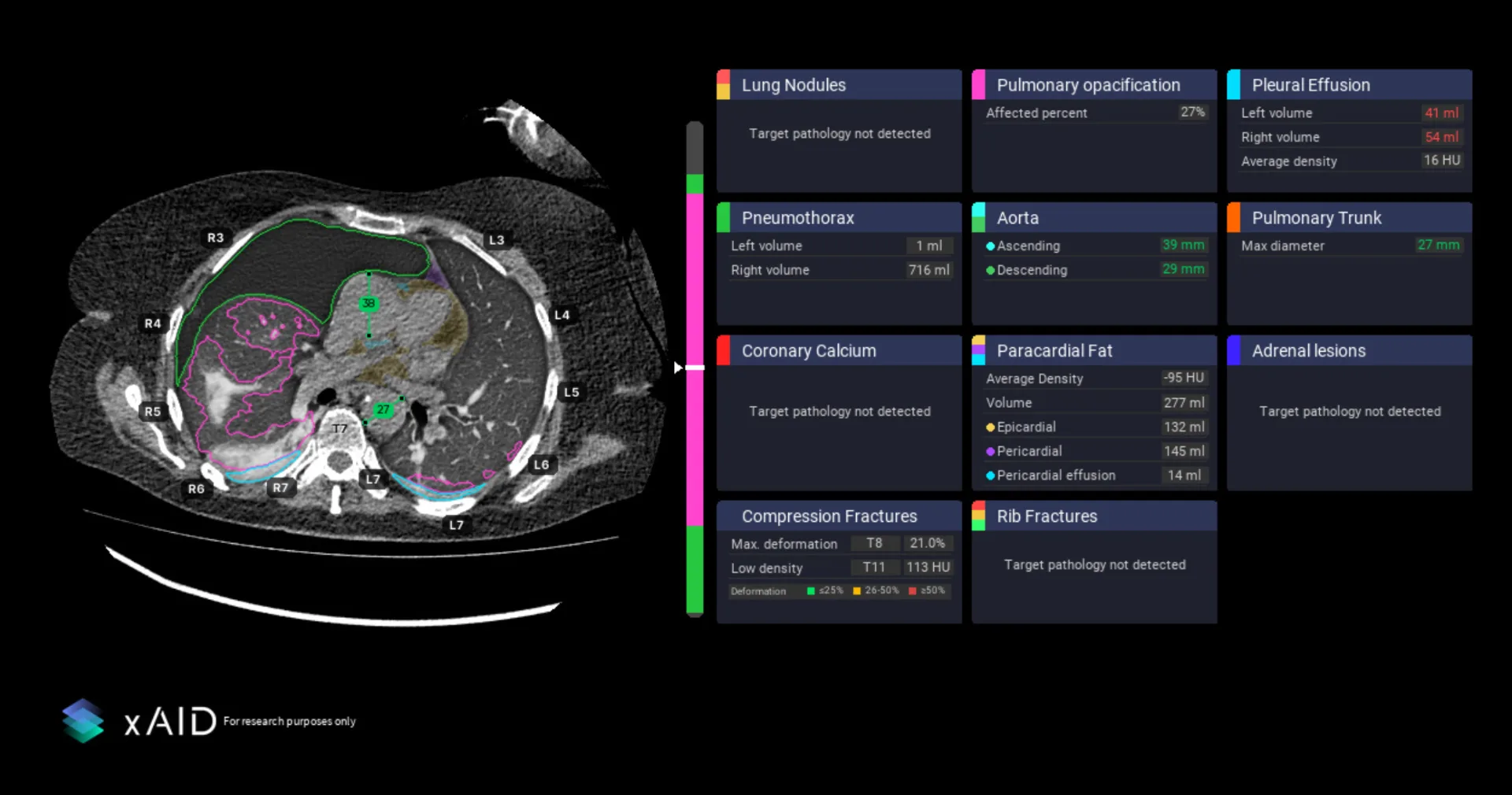
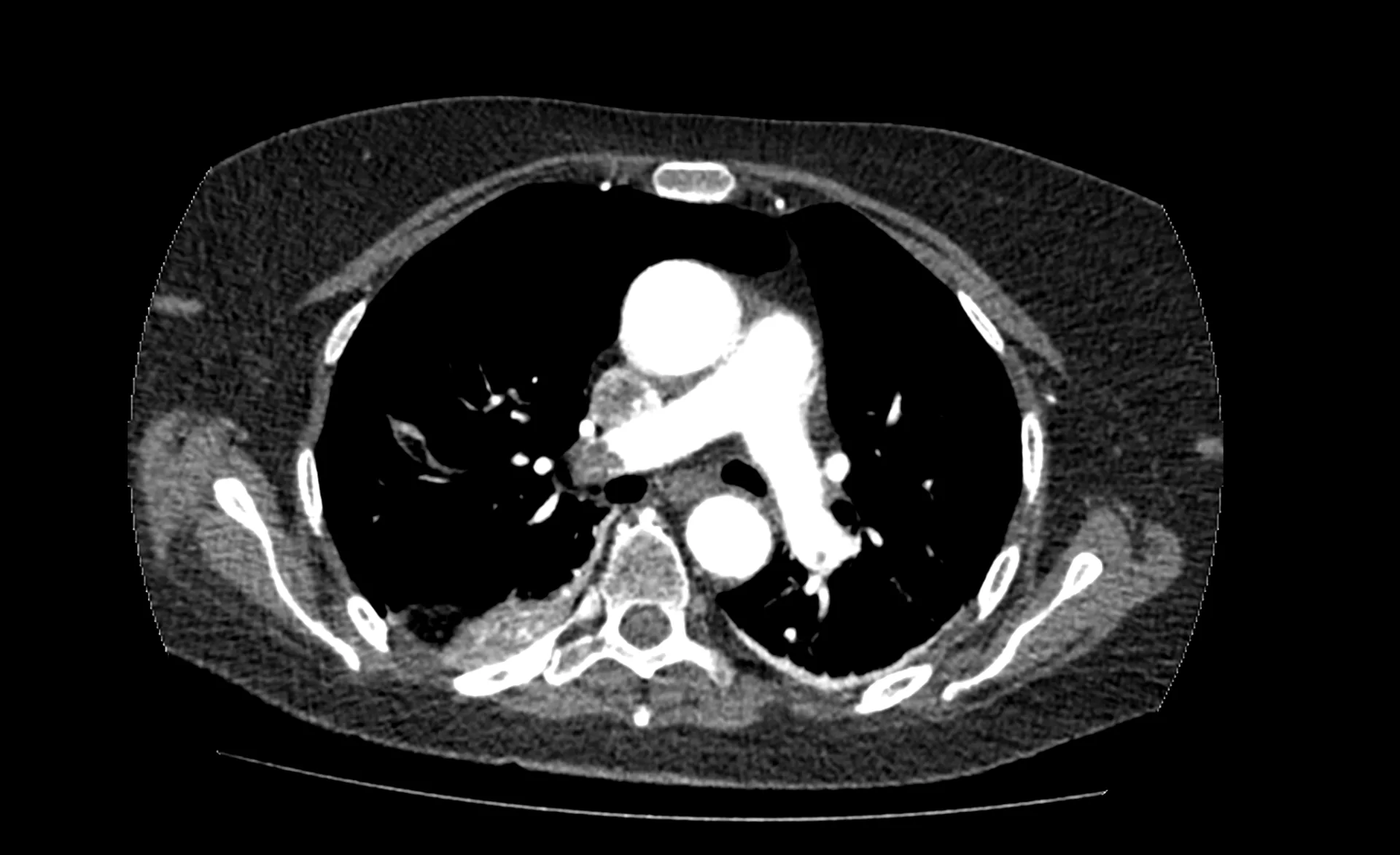
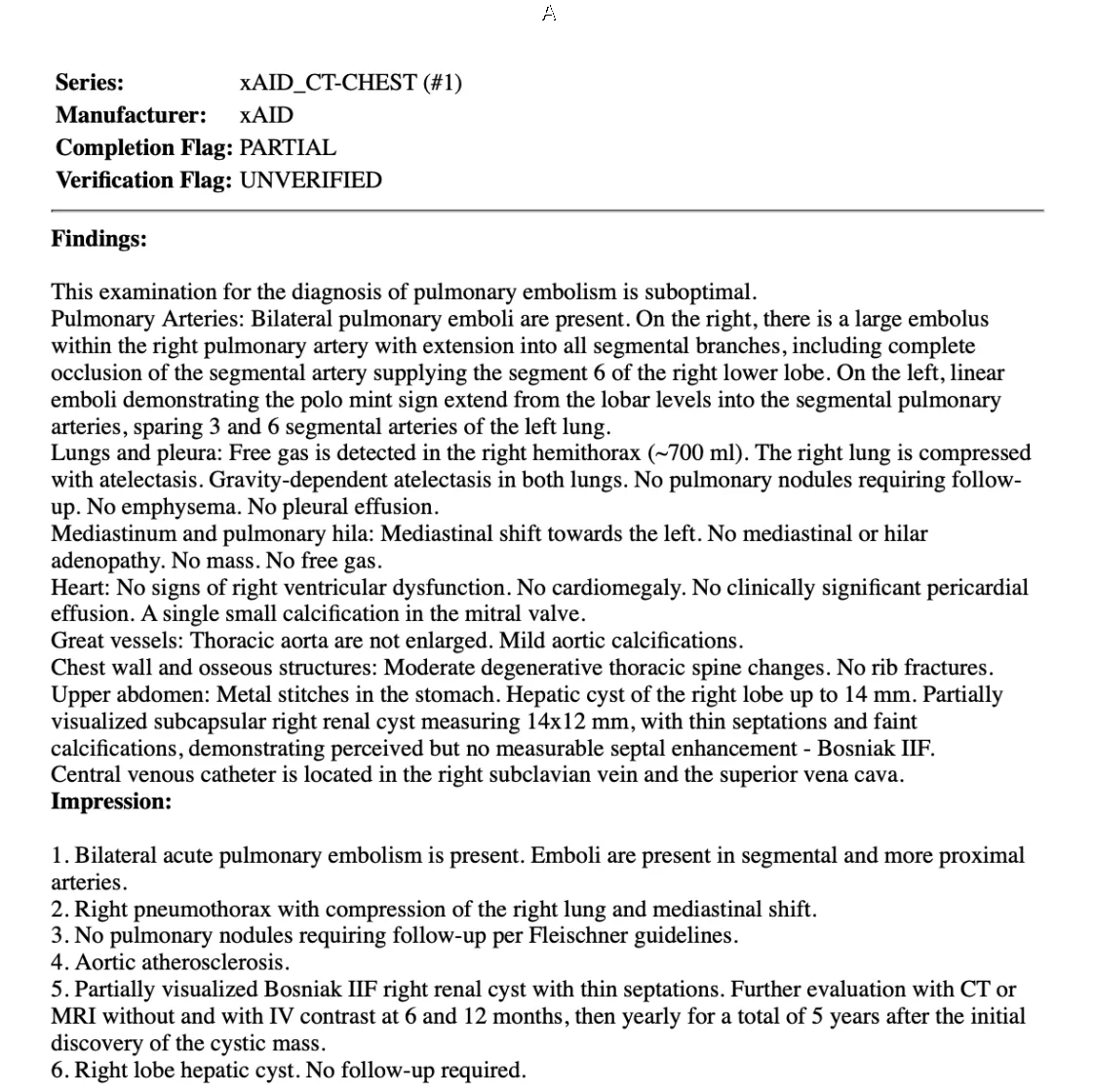
See what you're signing
Built to your template, compared against prior CT studies when supplied. Ready to sign
Questions from real calls
xAID achieves 95% accuracy verified by peer-reviewed studies — or we reimburse. Every report is also reviewed in-house by a European radiologist before delivery
2 to 12 hours from DICOM receipt to report delivery — 24/7, including after-hours and weekends, at no surcharge. The ACR guideline for routine CT is 24 hours; xAID typically delivers in a fraction of that. Configurable SLAs available for STAT and urgent studies
Locum radiologists cost $500,000–$650,000 per year for full-time coverage, take 2–4+ months to source and credential (a permanent hire takes 6–18 months), and carry burnout and turnover risk. xAID charges per study, sets up in under one week, and includes 24/7 coverage — with no staffing overhead. The rate is lower because the work is different: an in-house European radiologist reviews a complete AI-drafted report instead of dictating from a blank screen. What comes back is ready to sign — your own reading radiologist signs it
Your PACS sends CT studies to xAID via standard DICOM C-STORE. Ready-to-sign reports are returned via HL7 ORU message to your RIS — or as PDF. No custom middleware or development required. Most installations are complete in under one week
Yes. xAID is HIPAA-compliant and ISO 27001 certified. All patient data is processed exclusively in US-based, HIPAA-certified infrastructure. We sign a Business Associate Agreement (BAA) before your first study — not as a formality, but as the default
Head CT, chest CT, and abdomen CT — 100+ findings per report. xAID analyzes lung nodules, coronary calcium, stroke signs, hemorrhage, abdominal organs, fractures, vascular measurements, and more. When prior CT studies and their reports are supplied with the case, our radiologist reviews them and accounts for interval change. Standalone MRI reporting is on the roadmap
AI detection tools flag suspected findings and reprioritize the worklist, but the radiologist still reads and writes the full report from scratch. xAID is a full reporting service: AI analysis generates the complete structured report, which an in-house European radiologist reviews before delivery. The output from xAID is a ready-to-sign document; the output from detection tools is an alert. Detection tools are designed for hospital ED workflows; xAID is designed for outpatient imaging centers and teleradiology providers that need the complete report delivered
Traditional teleradiology typically charges $40–$80 per routine CT study with a 30–100% after-hours surcharge. AI CT reporting with xAID is priced at narrow AI rates — with radiologist review included in the per-study price and zero after-hours surcharge. For a mid-volume outpatient center with significant after-hours volume, the effective annual cost difference can exceed $200,000. See our full CT radiology coverage cost comparison for in-house, locum, teleradiology, and AI pricing side-by-side
For a complete transition: 1 week for a free pilot evaluation (no integration required), 3–5 business days for DICOM/HL7 integration, and an optional 2–4 week parallel period. Total: 2–3 weeks from first contact to full cutover. The DICOM/HL7 integration uses standard protocols your PACS already supports — most setups require 2–4 hours of PACS administrator time with xAID onboarding support
Meet the team


Anand Prabhakar, MD, MBA
Assistant Professor at Harvard Medical School and former Chair of Radiology at Mass General Brigham – Newton Wellesley


Get a free
5-study pilot
Send us 5 CT studies. See the reports
No integration required. No commitment
Get a free 5-study pilot
Send us 5 CT studies. See the reports. No integration required. No commitment
Address
8 The Green, Ste A, Dover, DE 19901, United States
Start your pilot
Fill in your details and we'll get in touch within 24 hours
From the blog
Coronary CT Angiography AI Just Found a Problem Nobody Ordered the Scan to Find
A coronary CT angiography AI study found elevated inflammation in 42.9% of asymptomatic, low-risk adults — including nearly half of those with zero visible plaque, a signal none of the standard risk tools caught. What that means for how reporting workflow handles a finding outside the original order.
Read →Pancreatic Cancer on CT Scan: The Signal Most Patients Fall Outside Screening For
A Mayo Clinic study of 1,825 PDAC cases found CT-visible muscle and fat changes years before diagnosis — in patients who never qualified for any existing high-risk surveillance program. The case for capturing body-composition metrics on every abdominal CT, not just targeted screening scans.
Read →What RSNA Told the FDA About Regulating Generative AI — A Buyer's Reading
RSNA and ACR filed formal comments on FDA's generative-AI discussion paper, calling for patient safety as the organizing principle and enforceable safeguards. Here's what that means for picking an AI reporting vendor before the rules are final.
Read →